A Dynamic Offloading Brace, Measured with MAI Motion
UniReliever®
Knee Brace.
A within-participant biomechanical study of adults with knee osteoarthritis, comparing no brace, an inactive brace and active offloading during functional movement — moving from “is a brace worn?” to “does activating it measurably change how the knee loads?”
8
Participants
3
Brace Conditions
2
Functional Tasks
Three Conditions, One Participant at a Time
Each person was their own control.
No brace
Baseline knee alignment under the control condition.
Inactive brace
The device was fitted with offloading disengaged.
Active brace
Offloading was activated as intended for real-world use.
Headline
Active offloading improved knee alignment in four of eight participants during squat. The detailed Results and Discussion report two of eight during sit-to-stand.
From Brace Wear to Measured Effect
Not whether a brace is worn — but whether activating it changes anything.
Dynamic braces aim to redistribute compartmental load and guide coronal-plane alignment in knee osteoarthritis. However, response may vary with anatomy, disease pattern, task and fitting. Markerless motion analysis offers a practical way to compare conditions objectively without a traditional laboratory marker set.
Does activation of the UniReliever knee brace alter knee abduction/adduction angle during repeated sit-to-stand and squat movement?
Mechanism
Three-point leverage using thigh and calf shells plus crossing dynamic force straps.
Activation
Dial-controlled offloading applies counter-pressure to shift stress away from the affected compartment.
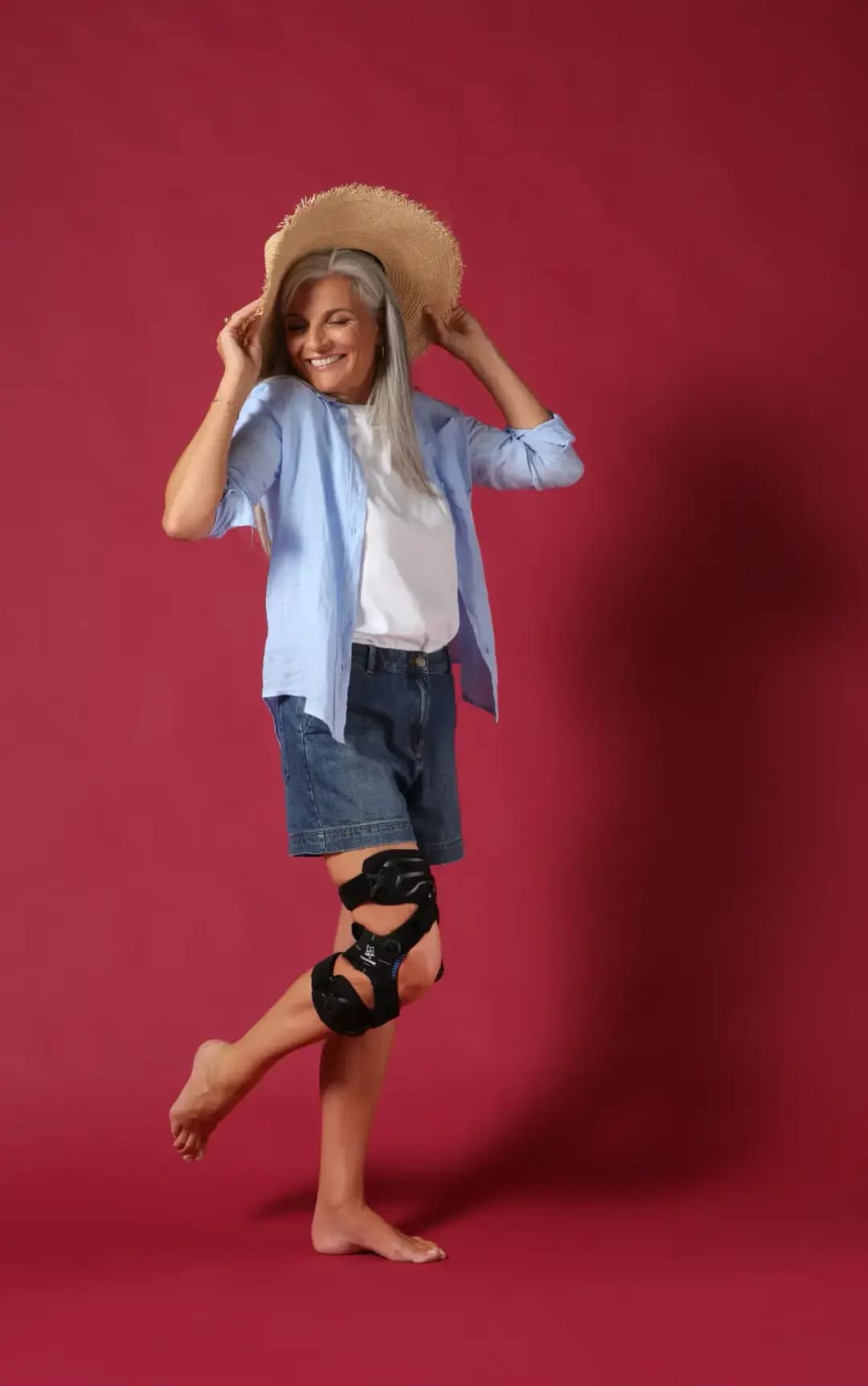
UniReliever knee TM5+ Hinge2 brace. Study Figure 1; product image attributed in the paper to Thuasne.
A Controlled Digital Movement Protocol
Eight adults, three conditions each.
Eight adults with medial- or lateral-compartment knee osteoarthritis completed repeated functional movements under three brace conditions.
7 : 1
Men : Women
6 : 2
Right : Left knees
30 fps
RGB capture
1920×1080
Resolution
Fit
The TM5+ Hinge2 brace was selected for the affected side and compartment, then aligned with the centre of the knee joint.
Record
Full-body video was acquired in a controlled indoor environment with consistent lighting and a neutral background.
Move
Each condition comprised five sit-to-stands followed by five squats; participants 1 and 5 completed three repetitions.
Analyse
MAI Motion calculated the three-dimensional knee abduction/adduction angle, reported as RAW angle minus 100 degrees.
Compare
Ordinary one- and two-way ANOVA with Holm–Sidak or Tukey multiple-comparison testing was performed in GraphPad Prism 10.4.1.
Included
Adults aged 18 years or older with compartment-specific knee osteoarthritis, suitable for an offloading brace and able to perform both tasks independently.
Excluded
Neurological or neuromuscular impairment, inability to perform the tasks safely, brace intolerance, or another interventional study affecting knee biomechanics.
Period & Governance
27 June 2023 to 30 July 2024 at MSK Doctors, Lincolnshire, UK. IRB approval M2300120006; informed consent obtained.
Response Was Not Uniform
Individual-level results.
MAI Motion detected improvement, little change and worsening across individuals, reinforcing the need to assess the person rather than infer benefit from brace wear alone.
Sit-to-stand
2 / 8 improved- Participants 4 and 8 improved with active offloading.
- Participant 6 worsened with active offloading.
- The inactive brace worsened alignment in participants 7 and 8; activation reversed this effect.
Squat
4 / 8 improved- Participants 2, 4, 5 and 7 improved with active offloading.
- Participant 8 worsened with active offloading.
- The inactive brace worsened alignment in participants 3, 7 and 8; activation reversed this in 7 and 8.
The dominant signal was between participants
96.32%
Sit-to-stand variation by participant
84.14%
Squat variation by participant
0.20%
Sit-to-stand variation by brace status
2.26%
Squat variation by brace status
Interpretation: the very large participant effect supports individualised assessment. These percentages describe sources of variation in this dataset; they are not treatment-effect percentages.
Activation Changed the Signal
Group-level results.
The inactive brace modestly worsened alignment in both tasks. Activating offloading reversed that effect, with the clearest group-level change during squat.
| Brace condition | Sit-to-stand mean (SEM) | Squat mean (SEM) |
|---|---|---|
| No brace | 8.27 (3.25) | 10.84 (3.06) |
| Inactive brace | 8.95 (3.04) | 11.43 (2.55) |
| Active brace | 8.02 (2.97) | 8.65 (2.71) |
Lower theta values indicate reduced knee abduction in the paper’s reported transformation. SEM = standard error of the mean.
Sit-to-stand
Inactive versus no brace: p = 0.0291. Active versus inactive: p = 0.0018.
Squat
Active versus no brace: p < 0.0001. Inactive versus active: p < 0.0001.
Key finding
The device in inactive and active modes was not biomechanically equivalent. Objective measurement can distinguish the effect of wearing the brace from the effect of engaging offloading.
Measured Response, Not Assumption
Clinical interpretation.
This exploratory study supports a pathway in which brace fitting is followed by objective movement reassessment, allowing settings to be refined for the individual.
Objective fitting
Measure knee alignment before and after activation rather than relying only on comfort or visual inspection.
Personalised optimisation
Identify responders, non-responders and those whose alignment worsens; refitting is a plausible next step but remains to be tested.
Remote monitoring potential
A standard RGB camera and markerless workflow may support repeat assessments beyond a specialist motion laboratory.
Research endpoint
Use the platform to link biomechanical change with future pain, mobility, adherence and quality-of-life studies.
Evidence boundary
Small cohort
Eight participants, including seven men and one woman, limit precision and generalisability.
Short-term
The study assessed immediate movement mechanics, not durable clinical benefit or structural disease modification.
Limited tasks
Sit-to-stand and squat do not represent gait, stairs or the complete range of daily activity.
No clinical endpoints
Pain, function, quality of life, adherence and economic outcomes were not evaluated.
Fitting hypothesis
The suggestion that refitting may improve non-response requires prospective testing.
Editorial accuracy note
The abstract states that active bracing improved sit-to-stand alignment in three patients. The detailed Results and Discussion identify two. This overview follows the detailed participant-level reporting and preserves the discrepancy transparently.
UniReliever® Knee Brace
Investigating the Effects of the UniReliever® Knee Brace Using Analysis of a Novel Digital Platform, MAI Motion.
Background
Knee braces are used to reduce pain and support mobility in knee osteoarthritis. This study assessed whether active offloading changed knee alignment, measured objectively using MAI Motion.
Methods
Eight adults performed repeated sit-to-stand and squat movements with no brace, an inactive brace and an active offloading brace. A 30-fps RGB camera captured movement; MAI Motion derived knee abduction/adduction angle. One- and two-way ANOVA tested individual and group effects.
Results
Participant identity accounted for 96.32% of sit-to-stand and 84.14% of squat variation. Detailed participant-level reporting identified active-brace improvement in two of eight during sit-to-stand and four of eight during squat. At group level, active offloading reversed the negative effect seen with the inactive brace.
Conclusion
MAI Motion detected subtle, individual biomechanical responses to an offloading brace. Larger and longer studies are required before concluding that these immediate alignment changes translate into sustained clinical benefit.
Published evidence — not assumption.
Objective, markerless measurement distinguishes wearing a brace from engaging its offloading — feeding directly into how MSK Doctors fits and reassesses joint-preserving devices.
Study Identity
- Authors:
- Tanvi Verma · Yan Wen · Paul Lee · Lei Zhang · Xujiong Ye
- Journal:
- Cureus 18(4), published 7 April 2026
- Article:
- e106571
- Licence:
- Creative Commons Attribution 4.0
Citation
Verma T, Wen Y, Lee P, Zhang L, Ye X. Investigating the Effects of the UniReliever® Knee Brace Using Analysis of a Novel Digital Platform, MAI Motion. Cureus. 2026;18(4):e106571. doi:10.7759/cureus.106571